Everybody on the Trail: A Guide to Adaptive Outdoor Gear by Activity
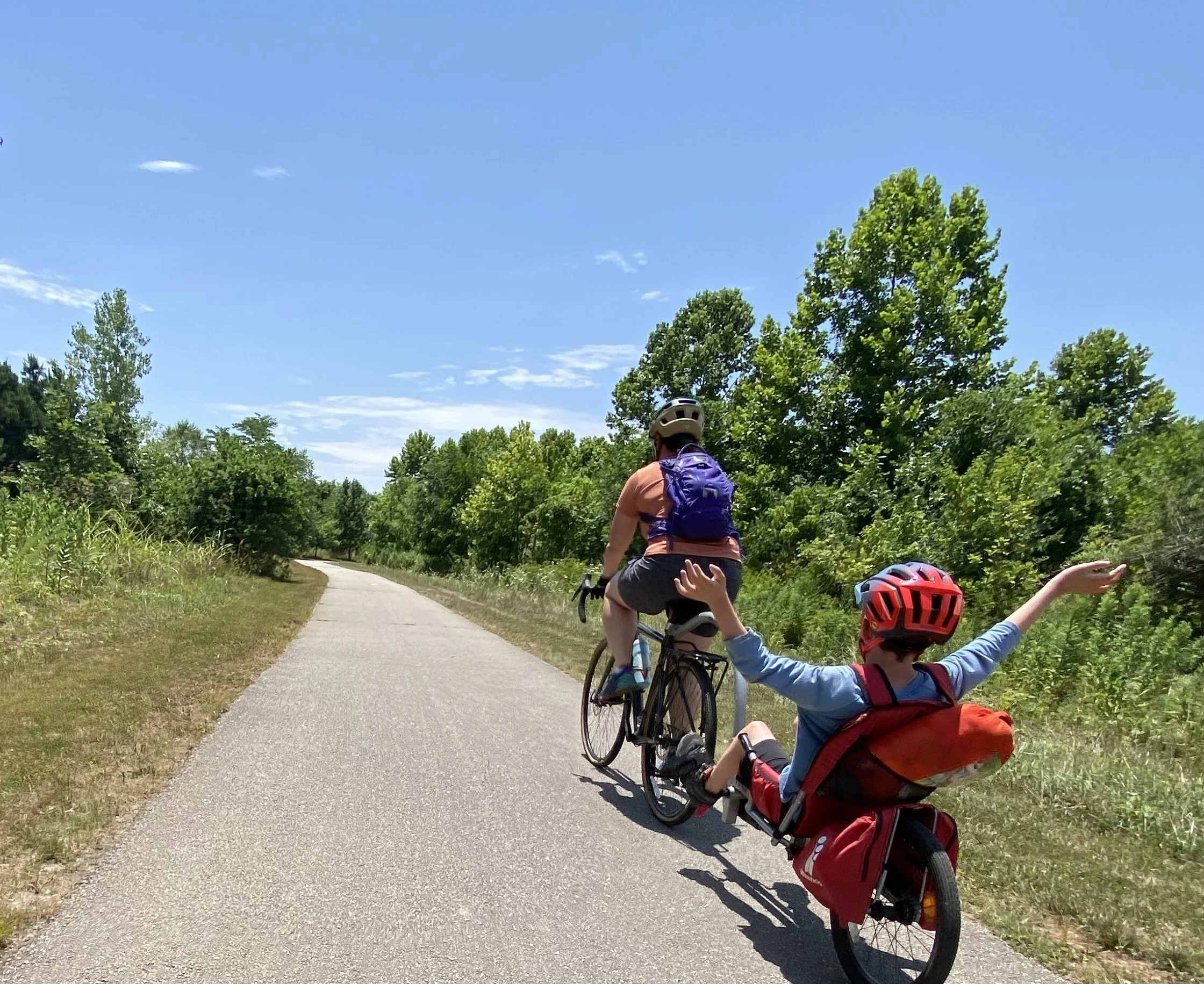
A bike trailer is a great way to get your kid out there with you.
We believe spending time in nature and the outdoors is important for human well-being. And we also believe that nature and the outdoors, in some capacity, should be accessible to everyone, regardless of ability, disability, or for any other reason.
Around here we talk a lot about inclusive access, and usually that means the sensory side of things - the tags, the textures, the overwhelm. But access has another whole dimension: the equipment that gets people with mobility differences onto the trail, into the boat, and up the wall in the first place, not to mention the way trails are constructed with adaptive equipment in mind.
Hiking and Getting Down the Trail
The headliner here is the all-terrain wheelchair, and a great example is the GRIT Freedom Chair. It’s a manual chair designed by MIT engineers that uses a lever-drive system (think mountain bike parts) to make pushing across dirt, grass, sand, gravel, and snow dramatically more efficient than a standard chair. It breaks down to fit in a car trunk, and it comes in sizes for all ages and bodies - there’s a youth version and a GRIT Junior billed as the first all-terrain kids’ wheelchair, so nobody gets left behind at the trailhead. For riders who want maximum ruggedness, the Spartan trim was originally built for obstacle-course racing.
The technology and engineering of all-terrain wheelchairs has come a long way and new makers and innovations continue to move ahead, making activities and places more accessible than ever.
One tip applies across every category below: many national and state parks, plus adaptive programs, now loan or rent all-terrain chairs right at popular trailheads. Always worth a call before buying.
Paddling and Getting on the Water
Watersports are some of the most adaptable activities out there, because so much of it can be adjusted piece by piece.
Start with the boat. Sit-on-top kayaks and wider-hulled boats are the usual recommendation, since the open deck makes transfers far easier for wheelchair users and the width adds real stability. A commonly recommended crossover boat is the Wilderness Systems Pungo, though plenty of models work well. But if whitewater kayaking is a dream, do know that there are paddlers out there who do amazing things in creek and playboats, too.
From there we layer on adaptations as needed. Outriggers - pontoon floats mounted to the sides - add major stability and make getting in and out much steadier. (They reduce tipping risk but don’t eliminate it, so caution still applies.) Adaptive seating replaces the stock seat with adjustable trunk and lateral supports. For simple pressure relief, gel and bead seats like the Jackson Sweet Cheeks or the Hobie Comfort Seat conform to the body and remove pressure points.
Adaptive paddles open things up for limited grip, strength, or one-arm paddling. Angle Oar’s Versa paddle mounts to the boat and pivots, taking the load off shoulders and wrists, and Dillenschneider Designs makes a well-regarded one-arm freedom paddle. A simple wrist-cuff-and-disc setup lets someone who can’t grip a shaft still paddle with real control. And transfer aids - benches, kayak “chariots” with wheels, and in some programs a Hoyer-style lift - make the move from wheelchair to boat safe and smooth.
Cycling and Getting Rolling
Bikes include a much wider, encompassing spectrum than what many of us have in mind. The main families look like this.
Handcycles are powered by the arms, for riders with limited leg mobility. They come recumbent (laid back, low center of gravity, easiest to transfer onto), upright, and in rugged off-road versions for trails.
Recumbent trikes use a reclined seat that supports the back and joints. Two front wheels and one rear (a “tadpole”) tends to be the most stable and is often recommended for riders with balance or visual differences, while one front wheel and two rear makes a “delta.”
Tandems are built for two, so a sighted or stronger captain steers up front while a stoker pedals behind. Side-by-side duets put riders shoulder to shoulder for easier communication, and wheelchair tandems let a chair dock right onto the frame, with no transfer required at all.
Therapeutic trikes for kids and adults come with adjustable supportive seating, foot straps, and steering limiters. They’re a common fit for balance differences, and for many autistic riders who simply feel steadier on three wheels.
E-assist can be added to any of the above, to flatten hills and stretch range when arm strength or stamina is the limiting factor.
When our son was younger, we also had bike trailers, such as the WeeHoo Bike trailer, that we towed everywhere. It took some practice, but once we had the hang of it, we all loved it!
Prices swing widely - a basic adaptive trike might run a few hundred dollars while a specialized handcycle or wheelchair tandem climbs into the thousands - which makes the lending and grant programs below especially worth knowing about.
Sailing and Feeling the Wind
Sailing is a very inclusive and adaptive sport that allows a person to be as relaxed or as active as they want to be. Few things rival the feeling of catching the wind and letting the water carry you, and adaptive sailing makes that feeling reachable for people with a wide range of physical abilities. The gear that opens this door starts with the boat itself. Purpose-built adaptive keelboats and dinghies—like the Hansa (Access) series, the Martin 16, and the SKUD—are weighted to be nearly impossible to capsize, so a sailor can focus on trimming the sail and steering rather than balancing.
Many pair with seating systems that add trunk support, swivel seats that make transfers easier, and dockside hoists or transfer boards that get you from chair to cockpit smoothly. For sailors with limited hand or arm function, servo-assisted and "sip-and-puff" control systems let you steer and adjust the sails using breath or a joystick, turning the whole boat into something you can pilot with the movement available to you.
If you're new to it, the easiest first step is finding a local adaptive or community sailing program (US Sailing keeps a directory), where trained volunteers and specialized boats are already waiting to get you out on the water.
Climbing and Getting Up the Wall
Climbing is more accessible than it looks, partly because gyms have exploded in number and partly because of one organization. Paradox Sports is a national nonprofit that runs adaptive rock and ice trips and, through its Adaptive Climbing Initiative (built with The North Face), has trained staff at gyms across the country to run inclusive programs. They also literally wrote the book: the first Adaptive Climbing Manual, pooling techniques from dozens of accomplished adaptive climbers.
The practical upshot is that if we’re new, we usually don’t need to buy anything at all. Head to a gym with an adaptive program, where trained instructors provide the harness, rope, and technique. Amputees often climb using an everyday prosthesis, a specialized climbing limb, or simply a protective sleeve over a residual limb. The systems exist to get an enormous range of bodies safely on and up that wall.
How to Actually Get the Gear Without Buying It All
This is the part that changes everything, because adaptive equipment is expensive and highly individual. Before spending:
Try before buying through an adaptive program. Local chapters, gyms, and recreation departments keep fleets of chairs, bikes, and boats specifically so people can test-ride and get a proper fitting.
Look for gear-lending libraries and trailhead rentals. Parks, nonprofits, and some outfitters loan all-terrain chairs and adaptive kayaks by the day.
Chase the grants. Foundations that fund adaptive equipment exist precisely because the sticker prices are so steep. Veterans can sometimes fund an all-terrain chair or handcycle through the VA, and several nonprofits will help with the paperwork.
And get a consultation for complex needs. For significant or complex disabilities, a fitting assessment (many paddle and cycle makers offer them) saves both money and frustration compared to guessing.
The Organizations Worth Bookmarking
A few names come up again and again, and they make wonderful starting points. Move United is the national umbrella, formed in 2020 from Disabled Sports USA and Adaptive Sports USA, with a huge network of local chapters, an equipment resource page, and sport-by-sport guides. Paradox Sports runs adaptive climbing programs, trips, and gym trainings nationwide. The Challenged Athletes Foundation offers grants, equipment resources, and clinics across many sports. Twin Cities Adaptive Cycling is a Minneapolis nonprofit running an adaptive bike share with a forty-bike fleet and fittings. And Heroes on the Water and Wasatch Adaptive Sports focus on paddling and multi-sport programs respectively. Also, don’t forget the Wounded Warriors Project.
The equipment to get almost any one of us outside already exists. The harder part is usually knowing it’s out there and finding the program that will let people try it. Even more so, you can be a part of someone’s supportive experience to adventure outside. Learn from the organizations mentioned, go with them, be a teammate to the person who’s embracing adaptive outdoor experiences - you’ll both learn from the adventure and have fun, too.