
A First Hike on Good Terms: A Quick Guide for Sensory-Sensitive Beginners
Quick answer: For a sensory-sensitive beginner’s first hike, solve friction and temperature ahead of time with seamless socks and light layers, talk through what to expect before you leave, keep the route short, flat, and close to the car, and treat an early turnaround as a win so they’ll want to go again.
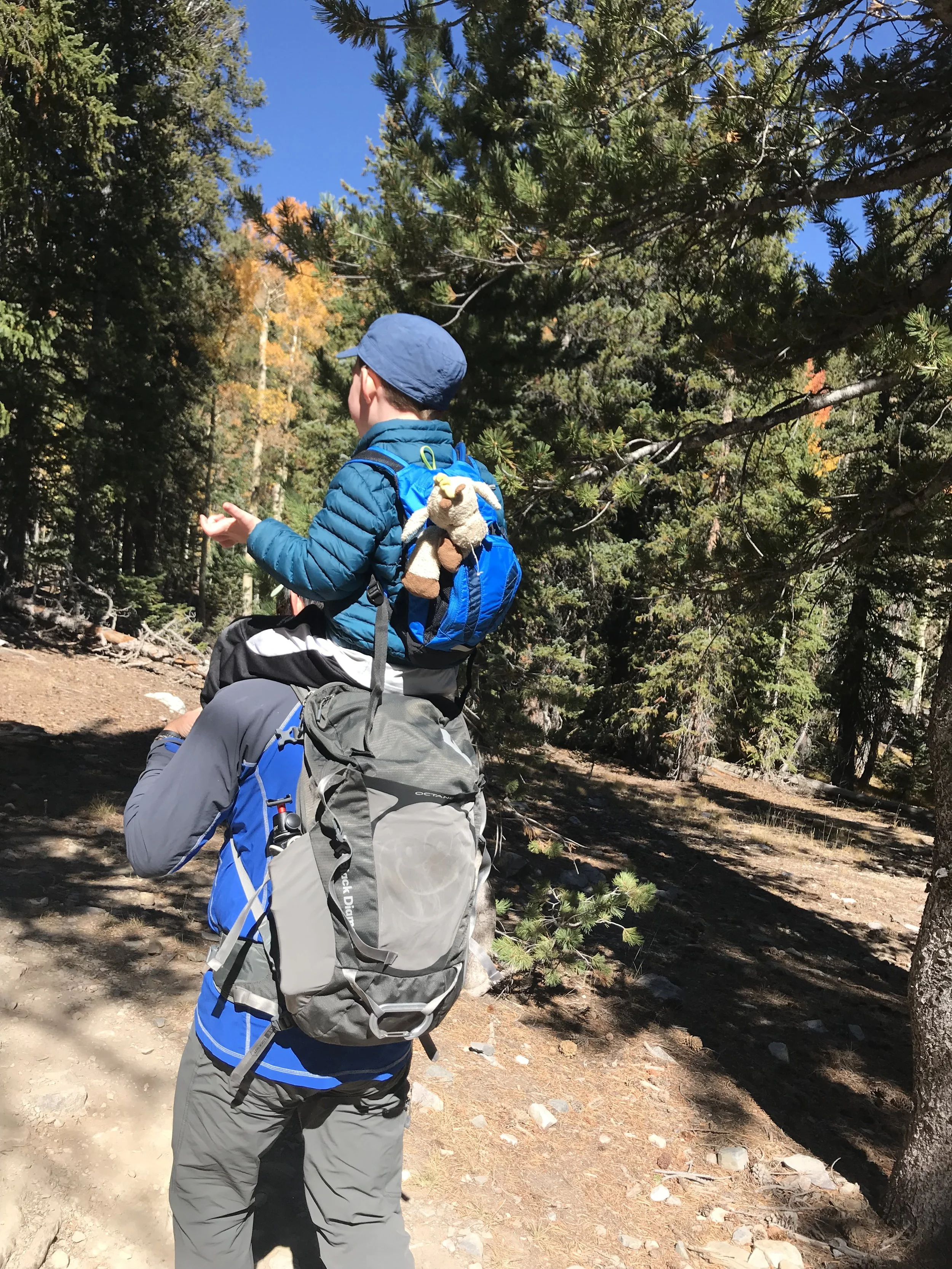
Traveling light is subjective!
Your First Hike, On Your Terms: A Guide for Overwhelm-Prone Beginners
Our first hikes with The Dude started with him either in a baby sling or a kid carrier backpack (like the Osprey or Deuter versions that we reviewed). Starting at a really young age made hiking feel like a natural part of our family’s activity and the carrier backpacks were a cushy way for him to ride through the world in comfort and with snacks.
That said, we also know that many people start hiking later than we did and that brings up a different way of easing in to a new activity. Frankly, even with a now-teenager, we sometimes have to coax the willingness to come along out of him!
Hiking is the gentlest doorway into the outdoors, which is exactly why it’s the best place to start when new experiences feel like a lot. There’s no engine, flexible timing, and no equipment we have to trust with our lives - just us and a trail. But “gentle” isn’t the same as effortless, and a first hike can still go haywire when the sensory load sneaks up on us. Here’s how to make that first hike an enjoyable activity that allows beginners to want to join in again.
This is part of our inclusive first-timer series, and each guide is built on the same five questions: what will this feel like, is the gear comfortable, how do we handle the unknowns, what’s the smallest first outing, and how will we know when to pause? Here’s how those play out on the trail.
What a Hike Actually Feels Like
The trail delivers a steady drip of sensory input rather than any one big cascade. Uneven ground underfoot that keeps changing. Weather we don’t control (sun, wind, temperature). Bugs. The weight and shift of a pack across the shoulders or sitting on hips. Long stretches of very similar input, which can be soothing for some of us and monotonous (bordering on agitating) for others.
The two that catch families off guard are temperature and friction. Many sensory-sensitive kids have a hard time reading their own body temperature. They won’t say “I’m too hot” - they’ll simply melt down once they’re already cooked. And nothing ends a hike faster than a sock seam across the toes or a pack strap sawing at a shoulder.
Get the Gear Comfortable First
Friction and temperature should be solved as best as possible before ever leaving the house.
Seamless socks are the single highest-leverage item in the bag. Toe seams are a top trigger, and moisture-wicking seamless pairs prevent both meltdowns and blisters in one go.
Layers that come off fast matter just as much. Not one thick layer, but several thin ones we can shed the instant someone starts to overheat. This is a regulation tool every bit as much as a warmth one.
A pack that actually fits needs padded, wide straps, and a hip belt can take a lot of the weight off the shoulders and back. It should be worn and adjusted at home first, fully loaded. For younger kids, unless they really want to carry their own smaller backpack, let them be packless.
And if brightness or glare is a sensory factor, test the hat and sunglasses ahead of time for brim and band comfort. (Our sensory-friendly clothing guide has specific brands for all of this.)
Handle the Unknowns Out Loud
Talk through the hike and what to expect before we’re standing at the trailhead. Roughly how long will the hike be (length/time)? Is it a loop or an out-and-back? Do we have break spots in mind already and what is the destination we’re aiming for? For a kid, previewing photos of the trail or even the parking lot removes a whole category of surprise. Name the what-ifs - what if I get tired, what if I don’t like it - and give each one a plan. Predictability is the calming ingredient here.
Design the Smallest Possible First Hike
We’re aiming for a win, not a view. The perfect first hike is short and flat, on a well-maintained, gentle loop or an out-and-back we can cut off anywhere. Skip the payoff vista on day one - a summit someone got dragged to in tears isn’t a win. Choose something nearby and familiar over a destination we’ve built up in our heads, and keep it close to the car with no committing terrain and no point of no return.
Ten happy minutes that end with “that was fun, let’s go home” will beat an hour of misery every single time. We’re building an association, and we want it to be a good one. We used to go on regular “teeny tiny flower walks” on our local greenways trails in the spring and early summer: looking at all the different kinds of flowers that popped up as the weather warmed and seeing how they slowly changed with every hike through the season.
Read the Signs, and Keep the Exit Shame-Free
Learn the early tells of overload. For a lot of kids, that’s well before the full meltdown, when they get quieter, more rigid, or more irritable. A tense body or stumbling, clumsier-than-usual movements are a sign of needing a break, or simply to finish. Treat turning around early as a success rather than a failure. “We can head back any time, no big deal” has to be genuinely true, or the whole trust structure collapses. When we needed to lift the feeling on the return trip (or even get into the action as we started the hike), we would play “touch the tree,” where we would take a moment to touch the trees we liked next to the trail, just to ground the physical feeling of barks under our hands. An adventure that ends on a good note is one we’ll willingly repeat, and repetition is the entire goal.
Hiking asks less of a nervous system than almost anything else outdoors, which is what makes it such a good proving ground. Sort the socks and the layers, keep that first one short and close to the car, narrate what’s coming, and let “we can stop” mean exactly what it says. Do that, and a first hike quietly becomes a second one - and the kid who “doesn’t do hiking” becomes a kid who does.