
Everybody on the Trail: A Guide to Adaptive Outdoor Gear by Activity
Adaptive equipment is available for more people across more outdoor sports than ever. Here’s a quick overview of different ways people with disabilities are getting outside with the adaptive gear that helps make it happen. Nature and the outdoors is everyone’s adventure playground!
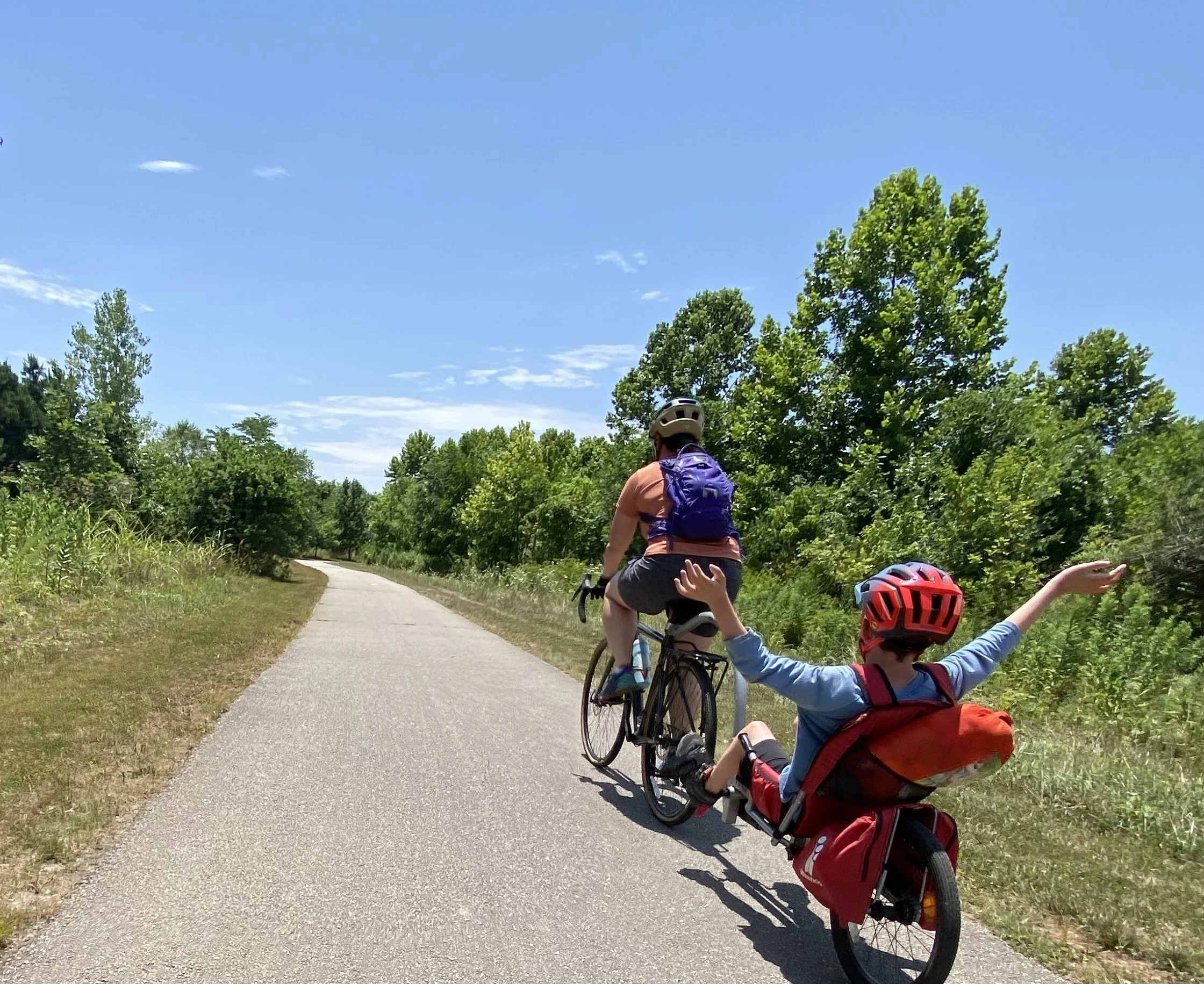
A bike trailer is a great way to get your kid out there with you.
We believe spending time in nature and the outdoors is important for human well-being. And we also believe that nature and the outdoors, in some capacity, should be accessible to everyone, regardless of ability, disability, or for any other reason.
Around here we talk a lot about inclusive access, and usually that means the sensory side of things - the tags, the textures, the overwhelm. But access has another whole dimension: the equipment that gets people with mobility differences onto the trail, into the boat, and up the wall in the first place, not to mention the way trails are constructed with adaptive equipment in mind.
Hiking and Getting Down the Trail
The headliner here is the all-terrain wheelchair, and a great example is the GRIT Freedom Chair. It’s a manual chair designed by MIT engineers that uses a lever-drive system (think mountain bike parts) to make pushing across dirt, grass, sand, gravel, and snow dramatically more efficient than a standard chair. It breaks down to fit in a car trunk, and it comes in sizes for all ages and bodies - there’s a youth version and a GRIT Junior billed as the first all-terrain kids’ wheelchair, so nobody gets left behind at the trailhead. For riders who want maximum ruggedness, the Spartan trim was originally built for obstacle-course racing.
The technology and engineering of all-terrain wheelchairs has come a long way and new makers and innovations continue to move ahead, making activities and places more accessible than ever.
One tip applies across every category below: many national and state parks, plus adaptive programs, now loan or rent all-terrain chairs right at popular trailheads. Always worth a call before buying.
Paddling and Getting on the Water
Watersports are some of the most adaptable activities out there, because so much of it can be adjusted piece by piece.
Start with the boat. Sit-on-top kayaks and wider-hulled boats are the usual recommendation, since the open deck makes transfers far easier for wheelchair users and the width adds real stability. A commonly recommended crossover boat is the Wilderness Systems Pungo, though plenty of models work well. But if whitewater kayaking is a dream, do know that there are paddlers out there who do amazing things in creek and playboats, too.
From there we layer on adaptations as needed. Outriggers - pontoon floats mounted to the sides - add major stability and make getting in and out much steadier. (They reduce tipping risk but don’t eliminate it, so caution still applies.) Adaptive seating replaces the stock seat with adjustable trunk and lateral supports. For simple pressure relief, gel and bead seats like the Jackson Sweet Cheeks or the Hobie Comfort Seat conform to the body and remove pressure points.
Adaptive paddles open things up for limited grip, strength, or one-arm paddling. Angle Oar’s Versa paddle mounts to the boat and pivots, taking the load off shoulders and wrists, and Dillenschneider Designs makes a well-regarded one-arm freedom paddle. A simple wrist-cuff-and-disc setup lets someone who can’t grip a shaft still paddle with real control. And transfer aids - benches, kayak “chariots” with wheels, and in some programs a Hoyer-style lift - make the move from wheelchair to boat safe and smooth.
Cycling and Getting Rolling
Bikes include a much wider, encompassing spectrum than what many of us have in mind. The main families look like this.
Handcycles are powered by the arms, for riders with limited leg mobility. They come recumbent (laid back, low center of gravity, easiest to transfer onto), upright, and in rugged off-road versions for trails.
Recumbent trikes use a reclined seat that supports the back and joints. Two front wheels and one rear (a “tadpole”) tends to be the most stable and is often recommended for riders with balance or visual differences, while one front wheel and two rear makes a “delta.”
Tandems are built for two, so a sighted or stronger captain steers up front while a stoker pedals behind. Side-by-side duets put riders shoulder to shoulder for easier communication, and wheelchair tandems let a chair dock right onto the frame, with no transfer required at all.
Therapeutic trikes for kids and adults come with adjustable supportive seating, foot straps, and steering limiters. They’re a common fit for balance differences, and for many autistic riders who simply feel steadier on three wheels.
E-assist can be added to any of the above, to flatten hills and stretch range when arm strength or stamina is the limiting factor.
When our son was younger, we also had bike trailers, such as the WeeHoo Bike trailer, that we towed everywhere. It took some practice, but once we had the hang of it, we all loved it!
Prices swing widely - a basic adaptive trike might run a few hundred dollars while a specialized handcycle or wheelchair tandem climbs into the thousands - which makes the lending and grant programs below especially worth knowing about.
Sailing and Feeling the Wind
Sailing is a very inclusive and adaptive sport that allows a person to be as relaxed or as active as they want to be. Few things rival the feeling of catching the wind and letting the water carry you, and adaptive sailing makes that feeling reachable for people with a wide range of physical abilities. The gear that opens this door starts with the boat itself. Purpose-built adaptive keelboats and dinghies—like the Hansa (Access) series, the Martin 16, and the SKUD—are weighted to be nearly impossible to capsize, so a sailor can focus on trimming the sail and steering rather than balancing.
Many pair with seating systems that add trunk support, swivel seats that make transfers easier, and dockside hoists or transfer boards that get you from chair to cockpit smoothly. For sailors with limited hand or arm function, servo-assisted and "sip-and-puff" control systems let you steer and adjust the sails using breath or a joystick, turning the whole boat into something you can pilot with the movement available to you.
If you're new to it, the easiest first step is finding a local adaptive or community sailing program (US Sailing keeps a directory), where trained volunteers and specialized boats are already waiting to get you out on the water.
Climbing and Getting Up the Wall
Climbing is more accessible than it looks, partly because gyms have exploded in number and partly because of one organization. Paradox Sports is a national nonprofit that runs adaptive rock and ice trips and, through its Adaptive Climbing Initiative (built with The North Face), has trained staff at gyms across the country to run inclusive programs. They also literally wrote the book: the first Adaptive Climbing Manual, pooling techniques from dozens of accomplished adaptive climbers.
The practical upshot is that if we’re new, we usually don’t need to buy anything at all. Head to a gym with an adaptive program, where trained instructors provide the harness, rope, and technique. Amputees often climb using an everyday prosthesis, a specialized climbing limb, or simply a protective sleeve over a residual limb. The systems exist to get an enormous range of bodies safely on and up that wall.
How to Actually Get the Gear Without Buying It All
This is the part that changes everything, because adaptive equipment is expensive and highly individual. Before spending:
Try before buying through an adaptive program. Local chapters, gyms, and recreation departments keep fleets of chairs, bikes, and boats specifically so people can test-ride and get a proper fitting.
Look for gear-lending libraries and trailhead rentals. Parks, nonprofits, and some outfitters loan all-terrain chairs and adaptive kayaks by the day.
Chase the grants. Foundations that fund adaptive equipment exist precisely because the sticker prices are so steep. Veterans can sometimes fund an all-terrain chair or handcycle through the VA, and several nonprofits will help with the paperwork.
And get a consultation for complex needs. For significant or complex disabilities, a fitting assessment (many paddle and cycle makers offer them) saves both money and frustration compared to guessing.
The Organizations Worth Bookmarking
A few names come up again and again, and they make wonderful starting points. Move United is the national umbrella, formed in 2020 from Disabled Sports USA and Adaptive Sports USA, with a huge network of local chapters, an equipment resource page, and sport-by-sport guides. Paradox Sports runs adaptive climbing programs, trips, and gym trainings nationwide. The Challenged Athletes Foundation offers grants, equipment resources, and clinics across many sports. Twin Cities Adaptive Cycling is a Minneapolis nonprofit running an adaptive bike share with a forty-bike fleet and fittings. And Heroes on the Water and Wasatch Adaptive Sports focus on paddling and multi-sport programs respectively. Also, don’t forget the Wounded Warriors Project.
The equipment to get almost any one of us outside already exists. The harder part is usually knowing it’s out there and finding the program that will let people try it. Even more so, you can be a part of someone’s supportive experience to adventure outside. Learn from the organizations mentioned, go with them, be a teammate to the person who’s embracing adaptive outdoor experiences - you’ll both learn from the adventure and have fun, too.

2021 Gear Gift Guide
Our roundup of favorite outdoor gear that stood out during the year — from merino beanies and solar lanterns to sleeping pads, coffee gear, pet finds, and cozy winter picks — for stockings and under the tree.
This post contains affiliate links. If you buy through our links, we earn a small commission at no extra cost to you. Thank you!
Do your friends have the tie-down straps they need to get that tree home? Read on for more stocking-stuffer ideas.
A spectrum of our favorites, collected and coddled through the year: here’s our Gear Gift Guide. These are items that really stood out to us or made our adventures better in some way. If you’re looking for something that isn’t a tangible item wrapped in a box, check out our “No-Box” Holiday Gift Guide, too.
Minus 33 Midweight Merino Wool Beanie. We met these folks at the Outdoor Media Summit, and — wow — their merino is amazing. They brought these beanies as swag, and it’s the softest wool we’ve ever felt. Well-made, with a great family start-up story behind the company.
REI gift card. Such an easy, no-brainer gift. Write a heartfelt message and let them choose from the candy store of outdoor gear. (For the women in your life, a Title Nine gift card is a great option too.)
MPOWERD solar lanterns. We talked about these in our multi-purpose gear post, and they’re back for the holidays. They shrink, glow, float, clip on, travel, and self-charge by solar. Tent, backyard, boat, or elsewhere, these will light the way.
Sea to Summit hanging toiletry bag. This was given to us a couple of years ago, and Cristen commandeered it — she hasn’t looked back. It has a ton of storage for its compact size and lots of organization, from hotels to sailboats to campground showers.
Kammok Roo Double camping hammock. We love hammocks and take them everywhere. If you have an outdoor lover who hasn’t yet enjoyed the bliss (and usefulness) of a hammock, this is a great one to stick under the tree.
Rab Dispatch 50L duffel. This duffel will get you there — and get all the souvenirs back, too. It’s sharp-looking on the baggage carousel, has thickly padded shoulder straps for the trek to your hostel, and is heavy-duty and water-resistant.
Osprey Transporter bags. We’re thinking of their commuter-style, laptop-carrying bags for folks getting back to the office or telecommuting from home or the local coffee shop. Padded laptop and tablet pockets, tons of nooks for pens, notebooks, and cables, and comfy straps that cinch close if you’re riding a bike to work.
Therm-a-Rest NeoAir XLite sleeping pad. We touched on these in our podcast episode about camping sleep systems. Your sleeping pad can mean the difference between a night and a great night — and Therm-a-Rest has led the charge on pads for decades.
Thermacell MR300 portable mosquito repeller. Our caveat: we use this on our sailboat, anchored near mangroves along the Florida coast in spring. If that’s not endorsement enough, it’s the size of a flashlight, lays on any surface, and works.
AeroPress coffee maker. We drink plenty of coffee — if you’ve listened to the podcast, you know local coffee shops are one of our favorite things to seek out in new towns. Our brewing evolved from an electric maker to a pour-over until we found the AeroPress. Now we can make coffee or great espresso, and it packs tight and goes everywhere. We’ve added a reusable metal filter and a USB-rechargeable frother over time.
Hiker’s Brew sampler and an insulated mug. While we’re on coffee, let’s complete the kit. Hiker’s Brew focuses on sustainable coffee in a small, multi-use, compostable package that keeps it fresh for the trail — and it’s some of our favorite. Add a two-cup insulated mug (we don’t mess around in the morning) and you’re set.
A clip-on safety light. A small clip-on that glows or flashes — perfect for a late run or trick-or-treaters, but we love putting one on our dogs’ harnesses when we walk them at night in campgrounds or marinas, so others can see them coming.
Upcycled bicycle-tube jewelry. Delicate designs made from discarded bicycle inner tubes — weightless, waterproof, upcycled jewelry, hand-drawn and laser-cut. Earthy accessories with unique flair, for bike lovers and beyond.
Sea to Summit Stretch-Loc straps. These. Are. Amazing. In lengths from 12 to 30 inches, they secure almost anything — bikepacking gear, SUP paddles, even roof racks. Talk about multi-use; it never hurts to have a couple in a pinch.
Eddie Bauer Kids CirrusLite Down hooded jacket. It’s tough to buy solid (and necessary) gear for kids when they grow so fast, but cold weather is nothing to mess with. Eddie Bauer’s kids’ winter coats fill that gap, and the CirrusLite has become our son’s favorite. It doesn’t hurt the wallet either, and there are lots of colors.
Therm-a-Rest Stellar tech blanket. Packable, fast-drying, warm, and lightweight, this one made our multi-purpose gear list, too. You might think you have enough blankets at home — but we daresay this replaces at least three of them. It’s so nice, even our dogs try to steal it.
Ruffwear Knot-a-Hitch dog tether system. We can’t leave the pets out. Our tail-waggers go almost everywhere with us, but many places require leashes, and a campsite can become a tangled mess. String this between two trees, clip on the lead, and the pups can move around camp safely while you set up and make dinner.
A cat travel tent. We can’t leave out the cat, either — he travels with us too. He’s not cooperative on a leash, so we make his RV life as interesting as possible. Seeing tiny dome tents made for cats finally hit the market makes my heart happy; now your cat can have their own basecamp on the road or at home.
Stasher reusable silicone bags. Sick of disposable plastic bags? Reusable silicone bags are our go-to at home, at school, on the road, and in the boat. They save money and landfill space, wash easily, and are easy for little fingers to open and close. We use them for food, crayons, magnets, and small toys.
REI Multi-Towel Lite. Once, we had a water leak in a small space and grabbed the nearest towel — this one. It holds eight times its weight in water, wrings out nearly dry, and goes back for more. It’s also so soft it nearly feels like a blanket, whether you use it for camp showers, hair, the beach, or hot yoga.
Hydro Flask Cooler Cup. Our quick-grab item this summer. It looks like a metal koozy for a can, but it also switches into a cup for hot or cold drinks. Every trip to the lake or pool, we stuck a cold can inside and that refreshing temperature lasted much longer.
Zippo HeatBank 9s rechargeable hand warmer. A winter item. Many of us have used chemical heat packs that last eight hours and get tossed. Now there are USB-rechargeable hand warmers (and versions that run on lighter fluid). For anyone who wants to get out on winter trails or slopes, having one in a pocket warms you up fast on the chilliest days.
Minus 33 merino socks. Beanies for your feet. Like the head version, Minus 33 didn’t skimp on quality or softness, and the padding under the heels and toes really stands out — perfect on hikes or while staying cozy on the couch.
Outdoor Research Gripper sensor gloves. Grab these on the way out the door and your hands stay warm all the way to school or the office — and you can still scroll, text, and check email with them on. Windproof and water-resistant, too.
Outdoor Research Kids Adrenaline mitts. We can’t leave the kiddos out. The snowball-shaping palm seems made for snow, as do the insulation and waterproofing. A longer collar and two cinch points keep them where they belong and the elements out, so the adventure lasts. (At least two candy canes fit in each mitten, safely, when hung by the chimney with care.)
Buffs. We’ve always loved Buffs for hair control, sweat control, style, and function — and shaping one into a balaclava makes even more sense than it used to. Stick one in a stocking and your loved ones will stay stylish and warm on runs, rides, hikes, and while shoveling snow.
Nemo Moonlite reclining chair. Imagine enjoying a lunar eclipse or a summer meteor shower from a steady camp chair that reclines — or kicking your feet up at a backyard fire ring with friends. Nemo makes a very comfortable chair. Pair it with a warm blanket and a hot drink and you’ve got a cozy night ahead.
Nemo Helio pressure shower. We don’t talk about this one enough. If you kayak, SUP, sail, take pets on trails or water, get muddy or dusty, mountain bike, rock climb, or van-life and boondock — anywhere it’d be nice to rinse feet, face, hands, or body without running water — you’ll love adding this. Even with the stickiest sand or dust, the pressure behind the spray gets you, the kids, and the pets clean enough to feel great before a long drive or turning in.
Ruffwear Highlands dog sleeping bag. Our dog, Jack, believes his body was made for soft things. Like the cat tent, this may be indulgent, but it makes us smile — and makes the dog feel special with his own matching, squishy bed. He’s one of the pack, after all.
MyMedic medical kit. Update those first-aid kits and keep them ready for the backcountry. There’s a size and arrangement for every activity, from road trips to day hikes to expeditions.
We hope our Gear Gift Guide helps! It’s always fun to put together — both to help with your holiday shopping and to look back at the creativity the outdoor industry keeps coming up with to make getting outside more comfortable and fun. All the best in your gift gathering, and happy holidays from Keyword Adventure!